For most hotels, waste disposal is a simple question of booking a collection. For a resort in a remote or seasonal location, it is rarely that easy. Municipal collection may be infrequent, expensive, unreliable, or in some places barely available at all, and the volume of waste can swing wildly between a packed high season and a quiet shoulder period. When collection cannot keep pace, waste piles up in exactly the kind of setting where clean surroundings are the product.
That is why more remote and seasonal resorts weigh up treating waste on site instead of shipping it out. We compare the two approaches honestly: how municipal collection works and where it struggles, what on-site incineration changes, and how remoteness and seasonality tip the balance.
How municipal collection works for a resort, and where it falls short
Municipal collection means relying on a local authority or contractor to remove waste from a site and take it to a central facility, usually a landfill or a transfer station. Where it exists and runs well, it is convenient and needs no capital outlay. The resort pays per lift or per contract and the waste becomes someone else’s problem.
The difficulties show up at the edges, which is exactly where remote and seasonal resorts sit. Collection frequency is set by the provider, not the resort, so a service built for a small local population may not match a large influx of guests. Distance drives up cost and emissions, as full skips are hauled long distances by road or ferry. And the resort has no real control over reliability: a missed collection, a closed road, or a landfill nearing capacity becomes the resort’s problem the moment bins start overflowing.
What on-site incineration changes
On-site incineration treats waste where it is produced, at the resort itself. Instead of storing waste for collection, the site reduces it to a small amount of inert ash. That shift has several practical effects:
- It removes most of the dependence on an outside collection schedule, so the resort is no longer at the mercy of a missed lift or an overloaded landfill.
- It sharply reduces the amount of waste that has to be transported off site, along with the cost and emissions of moving it.
- It handles the streams that need destroying rather than dumping, including food waste that would otherwise rot and attract pests, and clinical or contaminated waste from on-site medical facilities.
Where the heat is captured, a waste-to-energy system can put some of it back to use in hot water or heating, which matters at resorts where energy is expensive to import.
What it is not is a way to skip recycling. Recyclable material should still be separated and recovered wherever a route exists. On-site incineration is for the residual waste that collection handles poorly and recycling cannot take.
The remoteness factor
Distance is where the comparison often settles. The further a resort sits from a functioning municipal system, the weaker collection becomes as an option, and the stronger the case for treating waste on site.
Island resorts, mountain lodges and other remote properties may have no regular municipal service to rely on, or only one that involves shipping waste across water. Every load then carries a real cost in fuel, time and emissions, and every disruption to that chain leaves waste sitting on site. Treating it locally breaks that dependence.
The seasonality factor
The second deciding factor is how much a resort’s waste volume moves through the year. A place that is full for three months and quiet for the rest produces waste in a way that fixed collection contracts handle badly.
In peak season, a collection service sized for the local average is quickly overwhelmed, and waste accumulates faster than it can be removed. In the off-season, the resort may be paying for a contracted service it barely uses. On-site treatment scales more naturally with occupancy, because the resort runs the incinerator to match the waste it is actually producing.
A simple decision framework
Neither option is universally right, and in practice many resorts land on a mix. Municipal collection tends to make sense where a reliable, reasonably priced service already reaches the site, where volumes are steady, and where landfill or recycling facilities are close. On-site incineration tends to win where the resort is remote, where collection is unreliable, costly or absent, where waste volumes spike hard in season, or where clinical and biosecurity-sensitive waste has to be destroyed on site.
For most remote or seasonal resorts, the strongest answer is a hybrid: separate and recycle what can be recovered, use municipal collection where it works, and treat the residual, food and clinical waste on site to remove the dependence and the volume. This is the same logic behind cutting landfill reliance more broadly, which we cover in reducing landfill dependency for hotel groups.
Cost, compliance and getting the choice right
The comparison is not only operational. On-site incineration involves capital investment and running costs, plus trained operators and proper emissions compliance, where municipal collection trades those for an ongoing service fee and less control. The right answer depends on the true, long-term cost of each at your specific site, including the transport, the reliability risk, and the value of controlling your own waste.
Whatever the mix, the equipment has to be sized to the site and its seasonal pattern, and run to the emissions standards that apply locally.
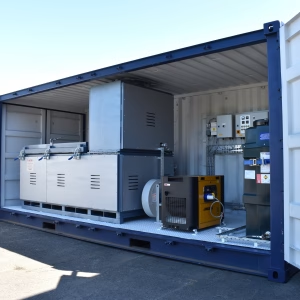
Inciner8 designs hotel and resort waste incinerators, from compact fixed units to containerised systems that suit seasonal demand and locations without fixed infrastructure. If you are weighing on-site treatment against collection for a specific site, tell us about its waste and our team will help you work out which approach, or which combination fits.