In May 2026, the World Health Organization declared the Ebola outbreak in the Democratic Republic of the Congo (DRC) a public health emergency of international concern (PHEIC). Unlike previous outbreaks caused by Zaire strains of the virus, this epidemic is driven by the Bundibugyo virus — a rarer variant with no approved vaccine or targeted therapeutics.
We examine what distinguishes the Bundibugyo strain, the scale and trajectory of the current outbreak, the response challenges on the ground, and the critical role that safe waste disposal plays in containing viral haemorrhagic fevers.
What Is the Bundibugyo Virus?
The Bundibugyo virus causes Bundibugyo virus disease (BVD), a form of Ebola that kills approximately a third of those infected. Unlike Ebola-Zaire strains, there are currently no approved Bundibugyo virus-specific therapeutics or vaccines available for clinical use, as noted by the WHO.
This absence of medical countermeasures makes the 2026 outbreak particularly concerning. Containment relies entirely on traditional public health measures: surveillance, contact tracing, infection prevention and control (IPC), and the safe management of infectious waste.
How Large Is the Current Outbreak?
The scale of the 2026 outbreak has escalated rapidly. As of May 31st, there are now more than 1,000 suspected Ebola cases in the DRC and at least 246 deaths. Neighbouring Uganda has reported nine confirmed cases and one death, with infections identified in the capital, Kampala.
Médecins Sans Frontières (MSF) has described the situation as “deeply alarming,” with deputy director Dr Alan Gonzales noting that never before has an Ebola outbreak recorded so many cases so soon after its official declaration. The true extent of infection remains uncertain. MSF has stated that hundreds of samples remain untested, and the WHO has highlighted that the high positivity rate of initial samples (eight positives among 13 collected across various areas) points towards a potentially much larger outbreak than what is currently being detected and reported.
The affected provinces (Ituri, Nord-Kivu, and Sud-Kivu) are in the northeastern DRC, bordering Uganda and South Sudan. International spread has already been documented, with confirmed cases reported in Kampala following travel from the DRC. Health officials in Brazil have also investigated a suspected case in São Paulo state involving a 37-year-old man who had recently returned from the DRC.
Why Is This Outbreak So Difficult to Contain?
Several factors are making the response to the Bundibugyo outbreak exceptionally challenging, stretching the capacity of national and international health systems.
No Approved Vaccine or Treatment
As mentioned, unlike Ebola-Zaire strains, there are currently no approved Bundibugyo virus-specific therapeutics or vaccines. The WHO has called on affected states to implement clinical trials to advance candidate medical countermeasures, but at present, containment depends entirely on non-pharmaceutical interventions.
Ongoing Conflict and Humanitarian Crisis
The affected regions of eastern DRC have experienced a protracted humanitarian crisis and ongoing insecurity. The WHO has repeatedly warned that conflict is significantly hampering the outbreak response. MSF has noted that containment efforts and humanitarian aid deliveries are being delayed by “major constraints,” including border and airport closures. The WHO’s own assessment references the lessons of the large Ebola virus disease epidemic in Nord-Kivu and Ituri provinces in 2018–2019, where insecurity, high population mobility, and the urban nature of hotspots compounded the risk of spread.
Healthcare-Associated Transmission
At least four deaths among healthcare workers in clinical settings suggestive of viral haemorrhagic fever have been reported from the affected area. The WHO has raised serious concerns regarding healthcare-associated transmission, gaps in infection prevention and control measures, and the potential for amplification within health facilities. Ensuring healthcare workers receive adequate training on IPC (including the proper use of personal protective equipment) and that facilities have appropriate equipment remains a stated priority.
Limited Diagnostic Capacity
Until recently, diagnostic samples had to be transported more than 1,500 kilometres to the DRC’s capital, Kinshasa, causing delays that health workers feared could cost lives and allow the virus to spread further. A laboratory in Bunia, Ituri’s provincial capital, now returns results within 24 hours. However, MSF has stressed that hundreds of samples remain untested, meaning the true scale and severity of the outbreak is not yet known.
What Measures Are Being Taken?
The international response has mobilised across multiple fronts. The WHO declared the outbreak a PHEIC on 17 May 2026, activating coordinated global preparedness and response mechanisms. WHO Director-General Dr Tedros Adhanom Ghebreyesus visited Ituri Province to oversee containment efforts, urging communities at the centre of the outbreak to play a larger role in fighting the disease. He warned that certain practices, including the touching of bodies of those who have died from Ebola, can spread the virus further.
The DRC and Uganda have been advised to activate national emergency management mechanisms, establish emergency operation centres, and implement comprehensive control measures. These include enhanced surveillance and contact tracing, strengthened IPC in health facilities, risk communication and community engagement, laboratory diagnostic testing, case management, and safe and dignified burial practices.
Border health measures have been scaled up. For example, the United States has introduced enhanced travel screening and entry restrictions for non-U.S. passport holders who have been in the DRC, Uganda, or South Sudan in the previous 21 days. The WHO has recommended exit screening at international airports, seaports, and major land crossings in affected countries, consisting of questionnaires, temperature measurements, and risk assessments.
The WHO has also stressed that no country should close its borders or place restrictions on travel and trade, warning that such measures push movement to informal border crossings that are not monitored, increasing the chances of disease spread and negatively affecting response operations from a security and logistics perspective.
How Does the Bundibugyo Virus Spread, and Why Does Waste Management Matter?
Ebola viruses normally infect animals, typically fruit bats, but outbreaks among humans can sometimes start when people eat or handle infected animals. The virus then spreads through direct contact with the bodily fluids of an infected person, including blood, vomit, diarrhoea, saliva, urine, and sweat. Transmission also occurs through contact with contaminated objects such as needles, bedding, or clothing.
In healthcare settings, this means that every item of contaminated PPE, every soiled dressing, and every used needle represents a potential vector for transmission. The safe destruction of infectious clinical waste is not a secondary concern during an Ebola outbreak – it is a frontline containment measure.
Inadequate waste disposal in treatment centres can undermine even the most rigorous IPC protocols. Where waste is stockpiled or improperly handled, the risk of environmental contamination and onward transmission increases. High-temperature incineration, capable of fully destroying pathogenic material, remains one of the most effective methods for eliminating infectious healthcare waste in outbreak settings – particularly in regions where waste management infrastructure is limited or non-existent.
How Inciner8 Supports Outbreak Response
Inciner8 has a proven track record of deploying incineration solutions during public health emergencies, including during previous Ebola and Covid-19 crises. Our systems have been supplied to the World Health Organization, the United Nations, and the Red Cross for use in crisis settings where the safe destruction of infectious waste is critical to protecting healthcare workers, patients, and surrounding communities.
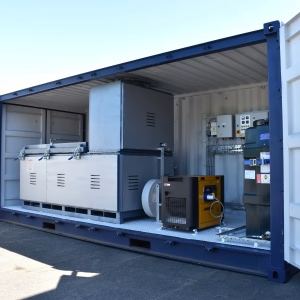
Our mobile and containerised Ebola incinerators are engineered for rapid deployment to remote and infrastructure-limited locations. Pre-installed with fuel and power connections, these units are made operational on-site with minimal setup, providing immediate capacity to safely destroy contaminated clinical waste.
With installations across more than 190+ countries and over 20 years of experience supporting healthcare providers, humanitarian organisations, and governments, our team understands the operational realities of working in challenging environments. From initial consultation and system specification through to installation and ongoing technical support, we work closely with response teams to ensure reliable, compliant waste management throughout the lifecycle of an operation.
If your organisation is involved in outbreak preparedness or response, contact our specialist team about rapid-deployment incineration solutions.